Last updated: June 6, 2026
What is a haboob?
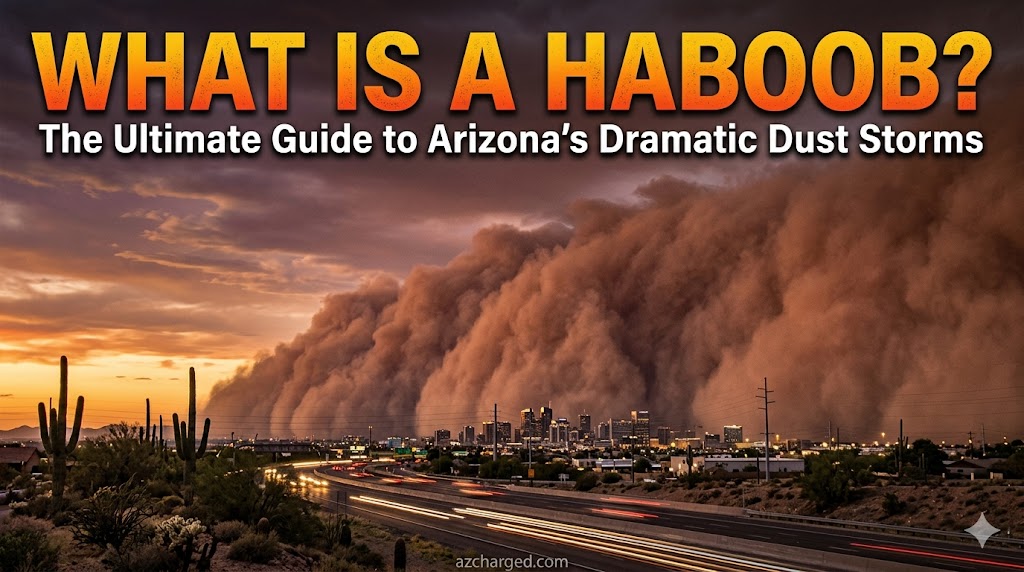
A haboob is an intense wall of dust driven ahead of a collapsing thunderstorm. When a storm’s downdraft hits the desert floor, it blasts air outward, kicking up a towering dust wall that can rise a mile high and stretch 100 miles. In Arizona they hit during monsoon season (June 15–Sept 30), most often in July and August. The word comes from the Arabic habūb, meaning “blowing furiously.”
If you’ve lived in the Valley more than a summer or two, you’ve seen one: a brown wall on the horizon, swallowing the South Mountain skyline, turning a 110° afternoon dark in minutes. Here’s what a haboob actually is, when to expect one, and — most important — what to do when you’re caught in it.
What causes a haboob?
A haboob forms when a thunderstorm collapses. According to the National Weather Service in Phoenix, the storm’s cold air crashes down to the desert floor in a “downburst,” then blasts outward and scoops up loose dust into a fast-moving wall ahead of the rain. That’s why a haboob can appear out of a clear sky — the dust wall arrives well before the storm that created it. They’re often followed by heavy rain, lightning, and flash flooding.
Arizona is built for them: dry soil, wide-open desert, and the seasonal monsoon winds that pull Gulf of Mexico moisture north to fire off the thunderstorms in the first place. The hotter and more unstable the day, the bigger the potential storm — which is the desert’s grim trade-off for surviving a 115° afternoon.
Haboob vs. dust storm vs. dust devil
People use these interchangeably, but they’re not the same thing. In Arizona, all haboobs are dust storms — but not all dust storms are haboobs.
| Type | What it is | Scale |
|---|---|---|
| Haboob | Dust wall driven by a collapsing thunderstorm’s downburst | Massive — up to a mile high, miles wide |
| Dust storm | Any blowing dust from strong winds stirring up loose soil | Varies — can be small and local |
| Dust devil | A swirling, tornado-like dust plume on a hot, calm day | Small, much lower wind speeds |
When is haboob season in Arizona?
Haboobs ride the monsoon. Arizona’s monsoon season runs June 15 through September 30, but the big dust events cluster in July and August when storm activity peaks. Maricopa County Emergency Management notes the Valley typically sees one to three of these major dust storms each year — so they’re not an everyday event, but when one comes, it dominates the sky.
Arizona’s most famous haboobs
| Date | What happened |
|---|---|
| July 5, 2011 | “The big one.” A dust wall a mile high and ~100 miles wide smothered Phoenix and made international news — the storm that popularized the word “haboob” in the U.S. |
| Aug 30, 2023 | A massive haboob rolled in during an ASU football game in Tempe, forcing a multi-hour stoppage. |
| Aug 25, 2025 | A haboob then monsoon knocked out power to thousands, grounded flights, tore part of the roof off Sky Harbor, and downed trees from Chandler to Scottsdale. |
Event details per The Arizona Republic and the National Weather Service.
⚠️ Caught driving in a haboob? Pull Aside, Stay Alive.
Dust storms are one of Arizona’s deadliest driving hazards — visibility can drop to zero in seconds. ADOT’s “Pull Aside, Stay Alive” guidance: if a dust wall is approaching, exit the freeway if you safely can. If you can’t, pull as far off the road as possible, put the vehicle in park, turn OFF all your lights including taillights, take your foot off the brake, and wait it out. Why lights off? Drivers in zero visibility tend to follow taillights — and rear-end the car they think is moving.
How to stay safe in a haboob
- Get indoors and stay there. Bring kids and pets inside; close windows and doors against the dust.
- If you’re driving, pull aside — off the road, in park, lights off, foot off the brake (see above).
- Don’t try to outrun it. A haboob moves fast and arrives ahead of the storm; you won’t beat it home.
- Mind your lungs. Blowing dust aggravates asthma and allergies — limit time outside until it clears.
⚡ AZ INSIDER TIP
The dust isn’t the worst of it — the rain right behind it is. Haboobs almost always lead a monsoon cell packing 60+ mph gusts, lightning, and flash flooding. So the move when you see the wall coming: get the cars under cover, pull the patio furniture and umbrella down, clear the pool deck, and check that your roof scuppers and yard drains are clear before the downpour hits. The dust is the warning shot.
After a haboob: dust, damage & cleanup
Once it passes, the cleanup is real — and in Arizona it’s predictable. Here’s what monsoon dust storms tend to leave behind, and the local help worth lining up:
- Clogged AC filters & coils. Fine dust chokes air filters fast and forces your system to work harder in peak heat. Swap filters after a big storm — and if airflow drops, see our best AC repair in Phoenix picks.
- Roof debris & lifted shingles. 60+ mph gusts loosen tiles and pack valleys with grit, which sets up leaks in the rain that follows. Worth a post-storm inspection — start with our Arizona roofing companies guide.
- Water intrusion. The monsoon rain behind the dust is where the expensive damage happens. If water gets in, move quickly — see how expensive water damage in Phoenix can get and our water damage restoration picks (or browse the full water damage directory).
For more on the weather that makes Arizona, Arizona, see our Scottsdale weather guide and what Arizona is known for.
Haboob FAQ
What does the word “haboob” mean?
“Haboob” comes from the Arabic word habūb, meaning “blowing furiously.” It originally described dust storms in Sudan and became common in the U.S. after the July 5, 2011 Phoenix storm.
When do haboobs happen in Arizona?
During monsoon season, which runs June 15 through September 30. The largest dust storms typically occur in July and August, with the Valley averaging one to three major events per year.
Are haboobs dangerous?
Yes — mainly on the road. Visibility can drop to near zero in seconds, making dust storms one of Arizona’s deadliest driving hazards. They also carry high winds, lightning, and flash flooding behind them.
What’s the difference between a haboob and a dust storm?
A haboob is a specific, large dust storm driven by a collapsing thunderstorm’s downburst. A regular dust storm can come from any strong wind. In Arizona, all haboobs are dust storms, but not all dust storms are haboobs.
What should you do if you’re driving in a haboob?
Follow ADOT’s “Pull Aside, Stay Alive”: exit the freeway if you safely can, otherwise pull far off the road, put the car in park, turn off all lights, and take your foot off the brake so others don’t follow your taillights into a collision.
Storm damage to clean up?
AZ Charged is a hand-curated directory of Arizona’s vetted local pros — AC, roofing, and water damage restoration that actually show up. No pay-to-rank.
📞 Got a business to recommend or list? Call (888) 863-7421 — serving Phoenix, Tucson, Flagstaff, Scottsdale and all of the great state of Arizona.